
Best Hair Ties for Fine Hair & What to Look For
Fine hair can be surprisingly difficult to tie well. You need enough hold to keep a ponytail or bun in place, but not so much grip that delicate strands are repeatedly pulled, snagged or compressed.
That is why choosing the right hair tie matters.
For fine hair, the best option is not necessarily the tightest. Look for something that balances a secure hold with a smooth surface, comfortable tension and easy removal.
This is where skinny silk scrunchies can be particularly useful.
Why can ordinary hair ties be difficult for fine hair?
Hair may feel strong, but repeated mechanical wear matters.
Scientific research into human hair shows that friction plays an important role in how the hair surface behaves and wears over time. Mechanical processes such as brushing, combing and styling can contribute to surface damage, particularly when hair is already dry, colour-treated or fragile.
A hair tie creates another regular point of contact.
A narrow elastic can concentrate pressure across a small section of hair. If it is tight, rough or catches during removal, it may create unnecessary pulling in the same area each time you wear your hair up.
This does not mean every ordinary hair tie damages hair. How tightly you wear it, how often you use it and the condition of your hair all matter.
But if your hair is fine or prone to breakage, choosing a smoother, gentler option makes sense.
What should you look for in a hair tie for fine hair?
The first consideration is the surface touching your hair.
A smooth fabric covering provides a softer point of contact than exposed elastic. It should also be easy to remove without catching or pulling individual strands.
The second consideration is tension.
A hair tie does not need to feel painfully tight to work. Dermatology research has shown that repeated traction from tightly pulled hairstyles can contribute to traction-related hair loss.
Your hairstyle should therefore feel secure rather than strained.
The third consideration is size. Fine hair often suits something lighter and more discreet than a large scrunchie, particularly for everyday ponytails and smaller buns.
That is one reason a skinny silk scrunchie can work so well.
Why choose a skinny silk scrunchie?
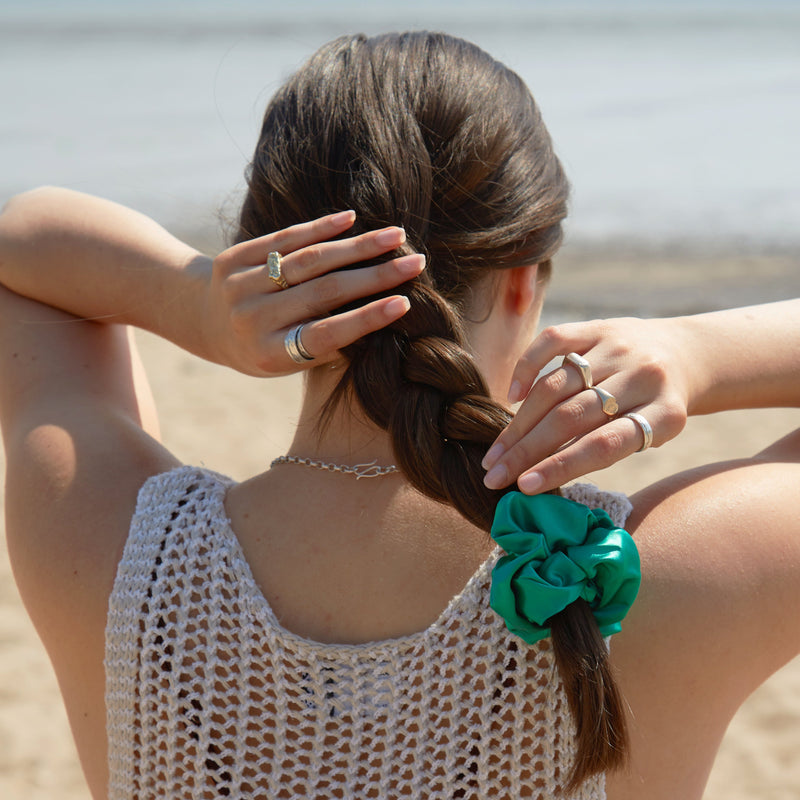
A skinny silk scrunchie combines the familiar shape of an everyday hair tie with a layer of smooth silk around the elastic.
At Silk Works London, our Skinny Silk Scrunchies are made from 100% Grade 6A, 22 momme mulberry silk.
Rather than exposing the hair directly to a narrow elastic, the silk forms the surface that comes into contact with the strands.
For fine hair, the slimmer proportion is particularly useful. It gives a more understated finish than a traditional large scrunchie while retaining the smooth silk covering.
The result is a hair accessory designed for comfortable everyday styling without unnecessary pulling or snagging.
Can silk scrunchies prevent hair breakage?
No hair tie can promise to prevent all breakage.
Hair can be affected by heat styling, colouring, bleaching, UV exposure, brushing and many other factors.
What a well-designed silk scrunchie can do is help reduce some of the avoidable mechanical stress associated with repeatedly tying and removing the hair.
Research into hair damage shows that friction, grooming and mechanical stress can affect the hair shaft. Dermatology literature also recognises repeated tension from hairstyling as something worth reducing.
It is therefore better to think of a silk scrunchie as one considered part of a gentler hair routine rather than as a treatment for damaged hair.
Are silk scrunchies good for fine hair?
For many people with fine hair, silk scrunchies can be a useful alternative to traditional uncovered elastics.
The smooth silk covering creates a softer surface around the hair, while a skinny scrunchie gives a lighter and more discreet shape than an oversized style.
The important thing is still how you use it.
Avoid pulling your ponytail unnecessarily tight and try not to secure your hair in exactly the same position every day. Changing the position of your hairstyle can help reduce repeated stress on the same strands.
Are silk scrunchies suitable for colour-treated hair?
They can be a particularly considered choice.
Chemical treatments such as colouring and bleaching can alter the hair surface. Research into hair friction suggests that chemical, thermal and mechanical processes can all contribute to changes in the condition of the hair.
If hair is already more vulnerable, reducing unnecessary snagging and excessive tension becomes even more important.
A smooth silk-covered hair tie used in a comfortably loose style can therefore form part of a gentler routine for colour-treated or breakage-prone hair.
Skinny or large silk scrunchies: which is better?
For most everyday styles on fine hair, a Skinny Silk Scrunchie is a natural starting point.
It is lighter, more discreet and well suited to low ponytails, smaller buns and simple everyday styling.
A larger Silk Scrunchie works well when you want a more visible accessory, a softer voluminous finish or more fabric around a loose bun.
Neither should need to be pulled painfully tight.
The best choice is the one that holds your hairstyle comfortably and can be removed without unnecessary snagging.
A gentler approach to tying your hair
Good hair care is rarely about one dramatic change.
It is usually the result of smaller decisions: how much heat you use, how you brush your hair, how tightly you style it and what comes into contact with it every day.
Changing your hair tie is one of the simplest.
Silk Works Skinny Silk Scrunchies combine an everyday shape with 22 momme, Grade 6A mulberry silk, creating a considered alternative for fine or delicate hair.